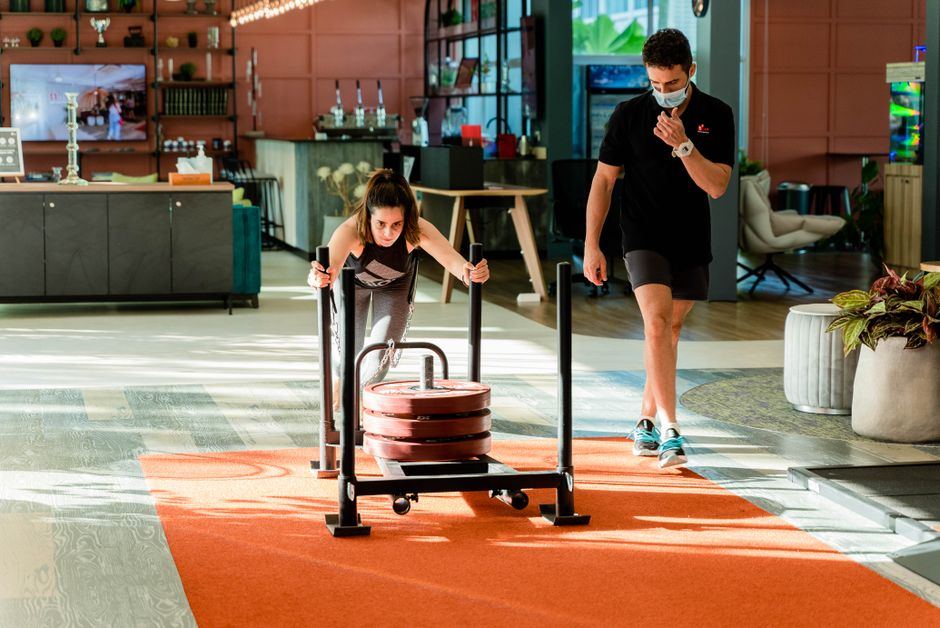
training sled push and pull workout routines buying guide

A structured way to actually use the sled you bought

The sled is only as good as the workout you run on it

Sled push and pull training works for speed, conditioning, and raw strength depending on load and distance -- here is what each looks like and which of our sleds fits each one.

See the workout-matched picks
⚡ Limited-time perk

Free two-day delivery on your pick

Get your pick delivered fast -- try Amazon Prime free for 30 days.

Sponsored link -- we may earn a fee if you sign up. No extra cost to you.

Quick answer: Our top pick for training sled push and pull workout routines is the PRISP Weighted Power Sled (Prowler) (Best for Mixed Push/Pull Circuits). If you're looking for best for heavy strength-focused sessions, the CFF 3.0 Heavy Duty Push/Pull Sled is a strong alternative.

One sled, several very different workouts

Reviewed by the HybridEquip team · last updated 2026-08-26

A sled push and a sled pull train different things depending on how you load and pace them, and most of the confusion around sled training comes from treating it as one workout instead of three or four. Speed/power work uses a lighter load pushed as fast as possible over 15-20m with 2 minutes of rest between short sprints. Conditioning circuits mix push and pull at lighter percentages of bodyweight (roughly 30-60%) back to back with minimal rest. Strength-focused sessions go the other direction: heavy load, shorter distance (about 20m), 90 seconds rest, for 8-10 rounds.

A simple weekly split some coaches use is a heavy strength-focused push day, a lighter conditioning or sprint day later in the week, and an optional light recovery session -- you do not need to hit max load every time you use the sled.

Of our five-sled lineup, two stand out for this kind of structured training. The PRISP Weighted Power Sled has both high and low push handle positions plus removable poles for pull-only work, which makes it easier to switch between push and pull drills in the same session without swapping equipment. The CFF 3.0 Heavy Duty is the pick once you are loading heavy for strength-focused push days -- its 1,000 lb rated capacity has plenty of room above even a demanding heavy-load protocol.

Match the sled to the workout, not just the budget

A sled built mainly for pull work (like a harness-only design) will not switch easily into push drills. If you want to run both push and pull in the same session, a sled with both handle poles and a pull-harness/pole option (like the PRISP) saves you from needing two separate pieces of equipment.

Light-load conditioning needs less sled than you think

Speed and conditioning protocols typically use 30-60% of bodyweight, which is well within reach of even the lighter sleds in a typical lineup -- you do not need a 1,000 lb-rated frame to run a conditioning circuit.

Heavy strength days are where frame capacity actually matters

Strength-focused sled work loads heavy and repeats for several rounds, which is where a higher-rated frame like the CFF 3.0 earns its price -- a lighter frame loaded near its rated ceiling repeatedly will wear out faster.

Product Best For Price Rating
PRISP Weighted Power Sled (Prowler) Best for Mixed Push/Pull Circuits $150 - $180 4.6/5
CFF 3.0 Heavy Duty Push/Pull Sled Best for Heavy Strength-Focused Sessions $250 - $300 4.8/5
Best for Mixed Push/Pull Circuits

PRISP Weighted Power Sled (Prowler)

4.6

High and low push handle positions plus removable poles for pull-only training let you run a push-then-pull circuit on one sled instead of switching equipment between drills.

  • Both high and low push handle positions for different drills
  • Removable poles convert it to pull-only for harness work
  • Compact 40 x 23.5 in footprint for home storage
  • Lighter frame than the CFF 3.0 for very heavy strength loading
Best for Heavy Strength-Focused Sessions

CFF 3.0 Heavy Duty Push/Pull Sled

4.8

A 1,000 lb rated capacity leaves plenty of headroom above even a demanding heavy-load, 8-10 round strength protocol, and replaceable skis hold up to the repeated heavy sessions that kind of training involves.

  • 1,000 lb rated capacity comfortably covers heavy strength protocols
  • Replaceable skis extend lifespan under repeated heavy use
  • Handles both push and pull in one frame
  • Overkill if you only plan to run light conditioning circuits
  • Highest price in our full lineup

Frequently Asked Questions

How much weight should I load for a sled push workout?

It depends on the goal. Speed/power work uses a lighter load pushed as fast as possible; conditioning circuits typically use about 30-60% of bodyweight; strength-focused sessions load heavy for shorter distances (around 20m) with longer rest (about 90 seconds) between rounds.

How many sets and reps for sled training?

A common starting structure is 3-4 sets of 10-20m pushes with 30-60 seconds rest for general training. Strength-focused work often runs 8-10 rounds of heavier, shorter pushes with about 90 seconds rest, while speed work uses fewer reps (6-10 short sprints) with longer 2-minute rest periods to keep output high.

Can I do both push and pull drills with the same sled?

Only if the sled supports both. Pull-only sleds (harness-based, no handle poles) cannot do push drills, and some push sleds lack a pull harness attachment. The PRISP in our lineup supports both through removable poles, which is worth checking for before assuming any sled covers both movement patterns.

Do I need a heavy-duty sled if I am only doing conditioning circuits?

No -- conditioning work generally loads at 30-60% of bodyweight, which most sleds in a typical lineup can handle without approaching their rated capacity. A high-capacity frame like the CFF 3.0 matters more for heavy, repeated strength-focused loading than for lighter conditioning work.